

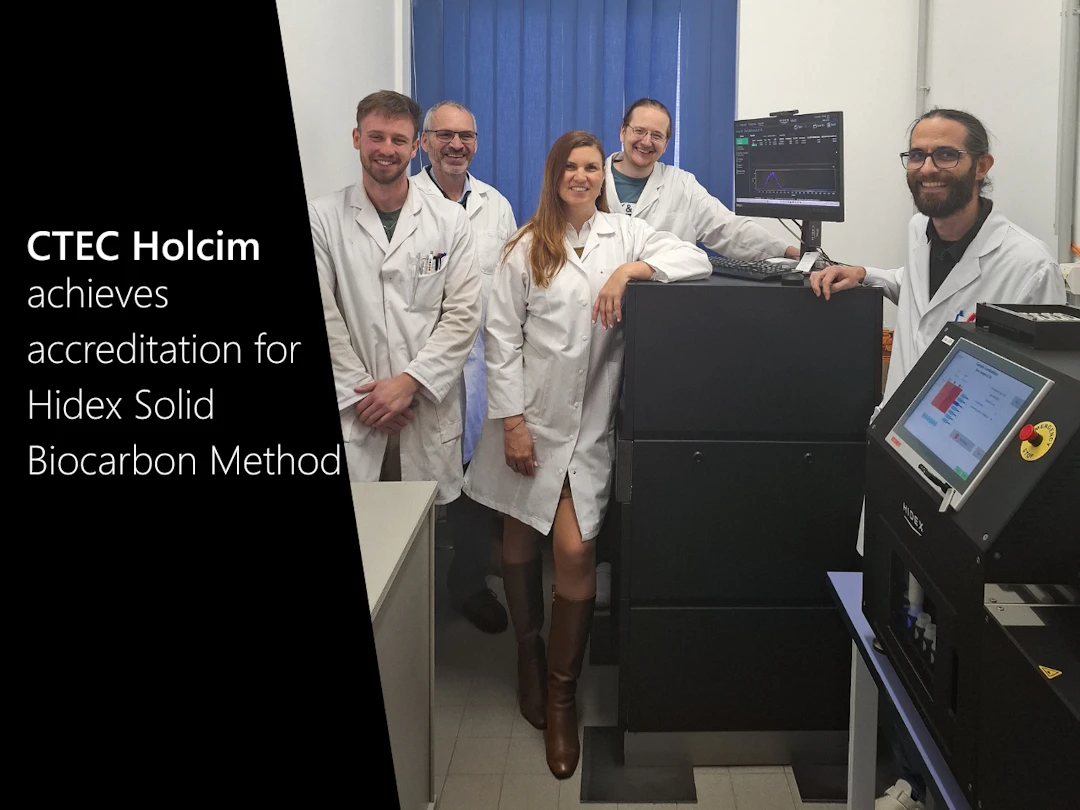
Customer interview story with - CTEC Holcim on achieving accreditation for the Hidex Solid Biocrbon Method
CTEC Holcim Cement Technical Center Vienna GmbH, part of the global Holcim Group, has strengthened its role in supporting sustainable cement production by implementing the Hidex ULLA and Oxidizer systems for biogenic carbon analysis in solid recovered fuels (SRF). The centre recently achieved third-party accreditation for the Hidex Solid Biocarbon Method, marking an important step in advancing reliable analytical capabilities for biomass analysis contributing to CO₂ reduction efforts within the cement industry. In an interview with Managing Director Gerold Schnedl and Deputy Lab Manager Stefan Baumann, we spoke about their onboarding experience of using Hidex equipment, how their lab received accreditation in record time, and how they utilise the Hidex Solid Biocarbon method for SRF.
Located in Mannersdorf, Austria, CTEC Holcim provides comprehensive analytical support for Holcim’s cement operations across Europe. Their work includes analysis of alternative fuels and raw materials, product development, and environmental testing, aimed at improving performance and supporting low-carbon production practices.
What are the main activities of CTEC Holcim?
The laboratory plays a central role in supporting Holcim’s Austrian cement plants in Mannersdorf and Retznei, as well as serving Holcim plants worldwide. Their work covers a wide range of analyses, including fuel characterization, biomass burnability and grindability testing, and environmental analysis.
A growing focus area is the analysis of secondary and alternative fuels, which help replace fossil-based materials, and reduce clinker content - the main source of CO₂ emissions in cement production, while maintaining durability and long-term product performance.
Why is biomass analysis important for the cement industry?
One of the key goals for the European cement sector is to reduce the CO₂ footprint associated with production. Since biomass is considered CO₂-neutral under emissions regulations, determining the biogenic fraction of fuels is crucial for accurate emissions reporting and participation in the EU Emissions Trading System (ETS).
By implementing analysis using the Hidex method, Holcim CTEC can precisely quantify the proportion of biogenic carbon in SRF samples, data that directly supports cement plant’s sustainability goals and regulatory compliance requirements.


